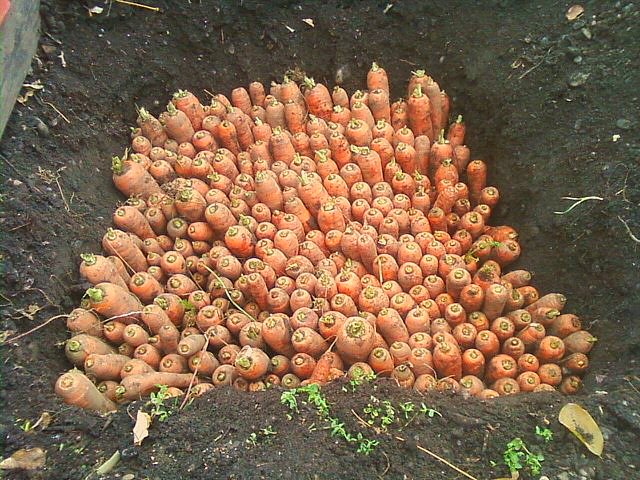
UNDERGROUND ROOT CELLAR - For extended fresh storage of carrots, use underground root storage. Prepare the carrots like you're going to store them in the refrigerator. Then pack into containers surrounded by straw or moist sand or sawdust for keeping in any outdoor storage pit or root cellar. Place them in an area just above 32 degrees Fahrenheit with 95 percent humidity.
Traditionally, this was done in a pit or clamp with a layer of straw and soil on top, along with potatoes. The clamp keeps the roots cool and slightly moist too. If an old fridge is available, it makes a very good store. Plastic bags with holes are quite good too, but the roots must have cool conditions or they will sprout. Storage in sand and soil is sometimes recommended but this can create earthy, woody off-flavours in carrots. Do NOT store near apples!
The method of preserving the root vegetables was known as 'clamping' and it involved storing the vegetables in what was known as a 'clamp'. The principles were:
to store only those vegetables that were in sound condition and to remove excess stalks and leaves that could rot in storage
to keep the stored vegetables slightly moist so that they did not dry out while keeping out the wet which would have made them rot
to prevent the frost getting to them
to prevent the light getting to them.
SAND BOXES - If you have the space, say in a garage, try the sand box method -
Lift the carrots for storage carefully with a fork and try not to damage or bruise them as damaged roots are subject to soft rot, which attacks through the wounds and causes a slimy decay, spreading out from the centre of the carrot.
Put the damaged carrots aside to eat immediately. Cut off the leaves of the carrot tops as near to the crown as possible without damaging them. Clean any soil off. Using slightly damp sand in boxes place the carrots in layers in a frost proof shed that is well ventilated. Remove for eating as required.
Be sure that the carrots are not stored in very damp conditions as they are likely to get Sclerotinia rot a fluffy fungus that causes them to become black and hard.
HOW TO STORE CARROTS (from World War Two pamphlet - but still relevant!) Official leaflet here.
The secret of storing carrots is in lifting them (pulling them up) in good condition. Lift them during dry weather, not later than the middle of October. Reject all blemished carrots and all damaged or forked roots. It is not necessary to clean them, but be careful to see they are quite dry.
You will need a dry shed for your storing, if possible with a stone or concrete floor, and some slightly moist sand. If you cannot get sand, earth taken from the top of the ground, shaken through a very fine sieve and slightly moistened, is the best substitute.
Lay alternate rows of carrots and sand (or earth) either on the ground, in pyramid shape, or in boxes. Cover your pyramid or box with sand (or earth). Put over it a layer of straw as a safeguard against frost. The carrots should be stored crown to tail in rows. Use the carrots as you require them, but take care that the remaining pile is always well covered. It is a wise plan to rebuild your pyramid at least once during the winter.
LEFT IN THE GROUND - Carrots can also be left for storage in the ground where they grew. Leaving in the ground is an option but roots left in the ground too long become woody and are prone to cracking.
To make winter digging easier cover the rows with leaves or straw then a layer of plastic then another layer of leaves or straw. The plastic keeps the bottom layer of mulch dry to make it easier to dig the carrots when ground is frozen. Make the top layer of mulch a foot deep and weight it down to prevent the leaves or straw from blowing away. Carrots will keep this way for 6 months. Be sure to dig carrots in the spring before warmer weather causes carrots to begin to grow again. Store in refrigerator when warmer weather comes.




 but I might try leaving a few to see how it would be to try to harvest them at the end of March or April when the ground thaws.
 .
.