A few pictures from this week

Here is a link to the Audubon field guide. You can click on sounds and hear the cry. Sweet little birds that are a sure sign of spring for us. I always see the nesting in the open gravel roads, field lane and parking lots! (I have yet to see them in shrubs!)

https://www.audubon.org/field-guide/bird/killdeer

in the fenced garden we try to steer them towards the less frequently used areas by filling their nests back in. this year they had an early enough start of it that they are already hatched by now. which is nice for planting season to not have to disturb them. the ones out front are just getting going this past week.

i don't ever see them nesting near or under shrubs - i'm thinking it might be a different bird.
 
s2iojmA.jpg

jED2WKO.jpg
 
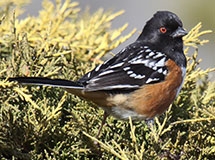
Med sized bird(compared to a sparrow or finch), dark color with flashes of some white on the fan tail. It moved so quickly into another shrub, its all I saw.
Thinking it is not the same Killdeer we see here. #1 nests are not hidden in shrubs and the just scrap a hollow out of the gravel! No soft bedding. #2 size wise they are bigger than your description.
 
Found her!

spotted_towhee_ganskopp.jpg

Spotted towhee
Pipilo maculatus
This well-known ground-dwelling bird is black above on the male and brown on the female, including the entire head and upper breast. On both sexes the upperparts are spotted with white on the wings and the long tail. It has rufous sides and a white belly.

It frequents brushy areas and is common at bird feeders wherever seed is scattered on the ground, but does not feed far from cover. The varied song usually has one to three parts.

The Spotted towhee breeds statewide and winters primarily west of the Cascades and in small numbers in lowland areas east of the Cascades.
 
Found her!

spotted_towhee_ganskopp.jpg

Spotted towhee
Pipilo maculatus
This well-known ground-dwelling bird is black above on the male and brown on the female, including the entire head and upper breast. On both sexes the upperparts are spotted with white on the wings and the long tail. It has rufous sides and a white belly.

It frequents brushy areas and is common at bird feeders wherever seed is scattered on the ground, but does not feed far from cover. The varied song usually has one to three parts.

The Spotted towhee breeds statewide and winters primarily west of the Cascades and in small numbers in lowland areas east of the Cascades.

purty birdie! :)
 
Found her!

spotted_towhee_ganskopp.jpg

Spotted towhee
Pipilo maculatus
This well-known ground-dwelling bird is black above on the male and brown on the female, including the entire head and upper breast. On both sexes the upperparts are spotted with white on the wings and the long tail. It has rufous sides and a white belly.

It frequents brushy areas and is common at bird feeders wherever seed is scattered on the ground, but does not feed far from cover. The varied song usually has one to three parts.

The Spotted towhee breeds statewide and winters primarily west of the Cascades and in small numbers in lowland areas east of the Cascades.
Pretty bird, can't say I have ever seen one. At least not around here.
 
does not feed far from cover...The Spotted towhee breeds statewide and winters primarily west of the Cascades and in small numbers in lowland areas east of the Cascades.
That's where I have seem them :).

They have been near rivers, foraging on the ground under bushes.

My community garden I recently referred to, was near both a river and a creek. The Towhee might be seen from my garden under bushes but I never saw one venture into it. The Song Sparrow does and their habits seem similar to me.

Steve
 

Latest posts

Back
Top