


Navigation
Install the app
How to install the app on iOS
Follow along with the video below to see how to install our site as a web app on your home screen.
Note: This feature may not be available in some browsers.
More options
You are using an out of date browser. It may not display this or other websites correctly.
You should upgrade or use an alternative browser.
You should upgrade or use an alternative browser.
Gardening Dictionary Thread
- Thread starter okiemommy
- Start date

chris09
Garden Ornament
..........................................A COMPLETE ANGIOSPERM FLOWER........................................
............
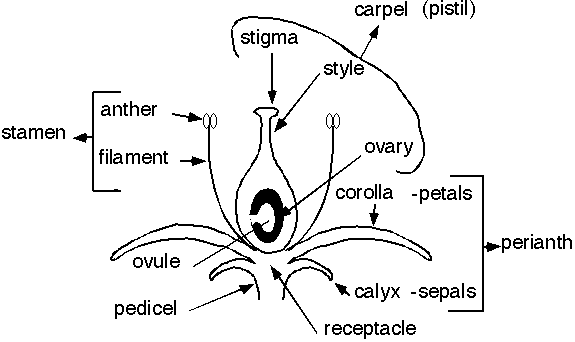 ..............
FLOWER PARTS OCCUR IN WHORLS IN THE FOLLOWING ORDER- SEPALS, PETALS, STAMENS, PISTILS.
PEDICEL - flower stem
RECEPTACLE - base of flower where other parts attach
SEPALS - small and green, collectively called the CALYX
PETALS - often large and showy, collectively called the COROLLA
PERIANTH - CALYX + COROLLA
STAMEN - composed of filament and anther
ANTHER - structure containing pollen grains
FILAMENT - structure connecting anther to receptacle
ANDROECIUM - collective term for stamens
CARPEL - structure enclosing ovules
PLACENTA - place of attachment of ovule(s) within ovary
STIGMA - receptive surface for pollen
STYLE - structure connecting ovary and stigma
OVARY - basal postion of pistil where ovules are located
The ovary develops into the fruit and contains ovules (eggs) which develop into seeds after fertilization.
LOCULE/CELL - chamber containg ovules
PISTIL - Collective term for carpel(s)
THE TERMS CARPEL AND PISTIL ARE EQUIVALENT WHEN THERE IS NO FUSION, IF FUSION OCCURS THEN YOU HAVE 2 OR MORE CARPELS UNITED INTO ONE PISTIL.
GYNOECIUM - collective term for pistils, a gynoecium can be composed of:
1. A single carpel = simple pistil
2. Two or more fused carpels = compound pistil
3. Two or more unfused carpels = two or more simple pistils
To determine the number of carpels in a compound pistil, count the locules, points of placentation, styles, stigma lobes, and ovary lobes.
COMPLETE FLOWER - A flower having all four whorls
PERFECT FLOWER - A flower having both sexes
UNISEXUAL FLOWER - A flower having one sex
MONOECIOUS PLANTS - A plant with unisexual flowers with both sexes on the same plant
DIOECIOUS PLANTS - A plant with unisexual flowers with one sex on each plant, in effect, male and female plants
http://botany.csdl.tamu.edu/FLORA/301Manhart/repro/Flower diagram/flower_diagram.htm
Chris
............
FLOWER PARTS OCCUR IN WHORLS IN THE FOLLOWING ORDER- SEPALS, PETALS, STAMENS, PISTILS.
PEDICEL - flower stem
RECEPTACLE - base of flower where other parts attach
SEPALS - small and green, collectively called the CALYX
PETALS - often large and showy, collectively called the COROLLA
PERIANTH - CALYX + COROLLA
STAMEN - composed of filament and anther
ANTHER - structure containing pollen grains
FILAMENT - structure connecting anther to receptacle
ANDROECIUM - collective term for stamens
CARPEL - structure enclosing ovules
PLACENTA - place of attachment of ovule(s) within ovary
STIGMA - receptive surface for pollen
STYLE - structure connecting ovary and stigma
OVARY - basal postion of pistil where ovules are located
The ovary develops into the fruit and contains ovules (eggs) which develop into seeds after fertilization.
LOCULE/CELL - chamber containg ovules
PISTIL - Collective term for carpel(s)
THE TERMS CARPEL AND PISTIL ARE EQUIVALENT WHEN THERE IS NO FUSION, IF FUSION OCCURS THEN YOU HAVE 2 OR MORE CARPELS UNITED INTO ONE PISTIL.
GYNOECIUM - collective term for pistils, a gynoecium can be composed of:
1. A single carpel = simple pistil
2. Two or more fused carpels = compound pistil
3. Two or more unfused carpels = two or more simple pistils
To determine the number of carpels in a compound pistil, count the locules, points of placentation, styles, stigma lobes, and ovary lobes.
COMPLETE FLOWER - A flower having all four whorls
PERFECT FLOWER - A flower having both sexes
UNISEXUAL FLOWER - A flower having one sex
MONOECIOUS PLANTS - A plant with unisexual flowers with both sexes on the same plant
DIOECIOUS PLANTS - A plant with unisexual flowers with one sex on each plant, in effect, male and female plants
http://botany.csdl.tamu.edu/FLORA/301Manhart/repro/Flower diagram/flower_diagram.htm
Chris

canesisters
Garden Master
bumping back onto the 'recent posts' area - there is some good stuff here

ducks4you
Garden Master
- Joined
- Sep 4, 2009
- Messages
- 13,402
- Reaction score
- 20,836
- Points
- 437
Holy Moley, allabout!!! VERY impressive! Here's another definition:
crop failure--when I try to grow something that takes too much care, needs too much watering, begs for too much "babysitting" and probably shouldn't be grown in my zone, ANYWAY!
crop failure--when I try to grow something that takes too much care, needs too much watering, begs for too much "babysitting" and probably shouldn't be grown in my zone, ANYWAY!
897tgigvib
Garden Master
- Joined
- Mar 21, 2012
- Messages
- 5,439
- Reaction score
- 929
- Points
- 337
Ya know...I think the ARTICLES section link in the green bar is empty.
Shall we fill it with some articles such as this dictionary?
Shall we fill it with some articles such as this dictionary?

Ooohh... thanks for noticing Marshall!
Actually I need to temp remove that until we decide:
1) Which system for articles we're going to use
2) If / how we're going to convert the old articles over (which are still live, just not linked to from here).
Actually I need to temp remove that until we decide:
1) Which system for articles we're going to use
2) If / how we're going to convert the old articles over (which are still live, just not linked to from here).
897tgigvib
Garden Master
- Joined
- Mar 21, 2012
- Messages
- 5,439
- Reaction score
- 929
- Points
- 337
Nifty, would it be alright if some of us members work together to create articles also? Perhaps in a format you approve?
This gardening dictionary would be a great one to start with.
This gardening dictionary would be a great one to start with.
Marshall, you're my new best friend! 
Not only would it be ok, but I'm working on ways to really encourage our members to have fun with creating articles.
I think you're on to a great idea with taking existing threads and consolidating the wealth of info into individual articles!
Keep the great ideas coming!

Not only would it be ok, but I'm working on ways to really encourage our members to have fun with creating articles.
I think you're on to a great idea with taking existing threads and consolidating the wealth of info into individual articles!
Keep the great ideas coming!


