Ok,
Hate me if you will, firstly you are hardly in a desert! I would wallow in 7inches of rain, but I think what your getting at is that you have to water and not nature alone. LOL

You might consider a drip system! I did notice on your other posts that you mounded around the base of each tree. In conditions of wanting to achieve 'deep root' watering a furrow is much better than a mound by far.
Seriously though, what part of this tree is sick? Can you describe the problem? To me it looks to be about 3-5 years old and in perfect order. These cuts you want to make are unnecessary because a redbud is really not meant to take heavy pruning. In time a redbud creates a natural canopy shape; a tall canopy or a short canopy is really the question here. Training a taller canopy through pruning is possible, however, some species of Redbud take on a lower posture, and some take on a higher one. Redbuds naturally are the undergrowth trees of a forest and are really responding to the gaps that are provided by the taller trees. What part of each of these branches are you not happy with? I mean, what are they doing that causes you to want to prune them? Is it height, is it width? Where are you trying to go with this tree? From the looks of things you do not intend to have any other trees surrounding or over it; just a freestanding tree, right?
I do think your choking it with all that support. Redbuds can take wind! The leaves can get trashed but they also continue throughout the year replacing leaves so one season will outweigh another.
Who did that support, was it a local Nurseryman? I would recommend removing it right away. The junction of main branches is exactly at this point and this kind of supporting can harbor bacteria and fungus, not to mention unwanted pests as the tree begins to increase the width. This is a critical juncture in the growth of these branches that will be supporting the top half of the tree and this method is pinching to say the least! All it takes is one year's growth and the expansion will have surpassed the room that is being given to it.
Are you sure your not a Beaver Brian? Four posts, each about a young tree, and in each post you want to take them to the nub of their existence. I say, "move away from those pruners!" Step back, take a breath, and reexamine why you feel you need to do this at such an early time in their development. Sure a branch or two with a minimal diameter causes less heal-time overall, but are we trying to achieve perfection overnight? And what is perfection? Your eagerness to correct something wrong when there is nothing wrong is wrong! LOL
The growing, living part of the tree is that thin bark covering the inner wood. The inner wood of the tree is inert and not growing (like a skeleton). Any breaks or pinches to this thin covering could cause a tree to begin to show signs of failing, and I dearly suspect this is the case (with all your
BABY trees). There is also a thing called 'Nurse Branches'; these are the young branches that fill in all the gaps and spaces. Their purpose for being there are to collect as much sunshine as possible and also to provide shade below. Over time Nurse branches are naturally shed by the tree as the tree matures. Most times they do not grow but suspend as small branches until later they are so insignificant the tree doesn't even support them anymore. They can be pruned as an assistance to time, or if one is clearly in your way, but they also carry on vital functions to a young tree and are very important at this point.
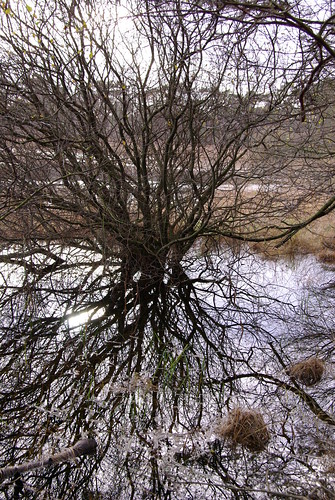
I would give all of your 'baby' trees at least a little elbow space and allow them to just flourish as they are. Be careful with any 'Cultivar' or grafted trees in that you are not mounding all that mulch up and around the graft site, as this can cause the tree to fail also. You might reconsider the mound and go with a furrow instead, allowing a deeper more appreciated watering. Surface water is fine for surface plants but as tall as these trees become is, potentially, as deep as the roots can one day reach. The secret to the drip-line and outreach of a tree's roots is best explained by looking at a tree with its reflection in a pool of water. For instance this picture:
See how the reflection portrays how the roots will grow? This is a condition of how the top half naturally is growing. Tall slender trees create deep single tap-roots, where-as wider canopy trees create a wider display of roots.
The reason I mention the roots is because of your mounds and how those mounds may not be supporting the tree properly based on the top half. Also it is a pretty picture LOL :coolsun
I am half rambling, but it really seems to me from your pictures that you need to plant more trees instead of focusing on pruning. Do a few raised beds, find a path to create, get some lawn furniture or something, but wait a bit before you go into such a heavy pruning. Your life may seem to be spinning by, but the life of a tree far surpasses our own and there is plenty of time for pruning.
Good luck,
Ron

ps, looking at Branch "A", I would say someone did this tree a dis-service by removing the end like the did. Now the tree is uneven in its canopy. It will eventually grow out to compensate, so no big deal at this point, but, from your prune markers that you put there I would say that you think that Branch "B" is a central trunk (as in the trunk continued upward). This is not the case. The trunk stops at the 'Stranglehold' of tie-downs! That is where the canopy begins. So you can go ahead and force this tree to do something it does not want to do, or, you can release it to flourish naturally so it may become a beautiful canopy! Again, this tree is perfect other than that one bad cut!
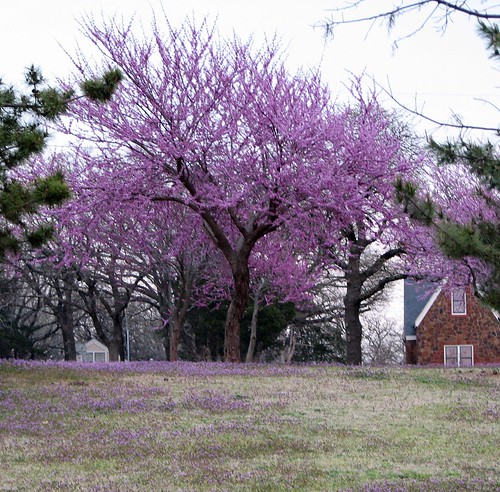
Here is a great example of a Redbud! Outstretched as it should be!
Minus 25-30 years I say the shape is identical to yours if you do not do any pruning at all!
edited to remove unnecessary rudeness





 Good luck to you,


